
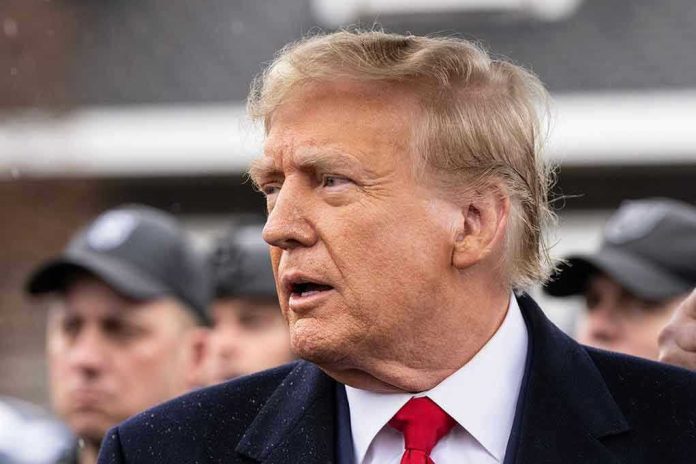
A federal judge has dismissed President Trump’s $20 billion defamation lawsuit against The Wall Street Journal over its report on a disputed birthday message in Jeffrey Epstein’s guest book, dealing another blow to efforts to hold media outlets accountable for what many Americans view as biased reporting.
Story Snapshot
- U.S. District Judge dismisses Trump’s defamation suit against WSJ without prejudice, citing failure to prove “actual malice”
- Lawsuit stemmed from January 2025 article about a lewd message in Epstein’s 2003 birthday book that Trump denies writing
- Judge ruled Trump’s complaint lacked specificity required for defamation claims against media outlets under stringent legal standards
- Trump’s legal team plans to refile amended complaint by April 27, 2026, deadline to continue the fight
- Case highlights ongoing tensions between political figures and mainstream media amid widespread public distrust of establishment journalism
Judge Rules Against Trump’s Media Accountability Effort
Judge Darrin P. Gayles of the U.S. District Court for the Southern District of Florida issued a 17-page ruling on April 13, 2026, dismissing President Trump’s defamation lawsuit against The Wall Street Journal, its parent companies News Corp and Dow Jones, along with CEO Robert Thomson, reporters Khadeeja Safdar and Joe Palazzolo, and chairman emeritus Rupert Murdoch. The dismissal came without prejudice, allowing Trump’s legal team to file an amended complaint. The judge determined Trump failed to plausibly demonstrate “actual malice” or specify financial damages required for defamation per quod claims, upholding the high legal bar established for public figures under the landmark 1964 New York Times v. Sullivan precedent.
Epstein Birthday Book Controversy Sparks Legal Battle
The lawsuit originated from a January 2025 Wall Street Journal article describing a leather-bound birthday album compiled by Ghislaine Maxwell for Jeffrey Epstein’s 50th birthday in 2003. The article reported a page containing a bawdy message inside the outline of a nude woman, with Trump’s signature underneath. The message was styled as an imaginary conversation ending with “may every day be another wonderful secret.” Trump immediately denied authorship, calling it “FAKE” and filing suit in July 2025 seeking $20 billion in damages. Following the lawsuit, House lawmakers subpoenaed Epstein’s estate and obtained a redacted version of the book matching the WSJ’s description, though Trump disputes its authenticity.
High Legal Standard Protects Media From Defamation Claims
The ruling underscores the substantial obstacles public figures face when challenging media organizations in court. Judge Gayles emphasized that the WSJ article included Trump’s denial, contacted the Trump administration, DOJ, and FBI before publication, and allowed readers to form their own conclusions about the disputed message. Legal analysts note these verification efforts directly contradict allegations of reckless disregard for truth required to prove actual malice. The judge’s decision aligns with consistent precedents rejecting what courts deem “conclusory” or formulaic malice claims lacking specific factual support. This high threshold, while protecting First Amendment freedoms, frustrates many Americans who believe media outlets face insufficient accountability for publishing unverified claims that damage reputations.
Trump Team Vows to Continue Fight Against “Fake News”
Following the dismissal, Trump’s legal team issued a defiant statement pledging to “refile this powerhouse lawsuit” and “hold accountable those who traffic in Fake News.” The team has until April 27, 2026, to submit an amended complaint addressing the judge’s concerns. The Wall Street Journal declined to comment on the ruling. Trump has pursued multiple defamation lawsuits against major media outlets including ABC News and CNN, with many dismissed on similar grounds. The case represents broader frustrations shared by millions of Americans across the political spectrum who believe powerful media corporations, often aligned with establishment interests, operate with impunity while shaping public perception through selective reporting and unverified allegations.
Federal Judge Dismisses Trump's Defamation Lawsuit Against The Wall Street Journal Over Epstein Birthday Letter Report https://t.co/kpdZ7y645U #Money #Finance #Economics #Market
— Alen Karabegovic (@AlenKarabegovic) April 14, 2026
The dismissal, while a procedural setback, leaves the door open for Trump to strengthen his legal arguments. However, the rigorous actual malice standard continues to shield media organizations from accountability in ways that many ordinary citizens facing defamation would never enjoy. This double standard reinforces perceptions that elites in media and government play by different rules than everyday Americans, fueling distrust in institutions that claim to serve the public interest while protecting their own power and influence.
Sources:
CBS News – Trump Wall Street Journal Lawsuit Epstein
Politico – Trump Epstein Lawsuit WSJ