Iran’s vow to deliver a “decisive response” to British warships in the Strait of Hormuz raises the risk of a miscalculation that could choke a vital energy lifeline and confirm fears that great-power brinkmanship trumps public interest.
Story Snapshot
- Iranian officials assert control over the strait and warn foreign navies, while denying U.S. claims of boat losses and damage to allied ships [1][2].
- United States Central Command reports U.S. destroyers successfully repelled Iranian attacks and completed passage, disputing Tehran’s narrative [1][4][8].
- Commercial shipping faces rising hazards as incident reports and traffic declines suggest a degraded operating environment [2][9][14].
- Competing legal claims over navigation rights and sovereignty harden, increasing odds of escalation with global economic stakes [6][9][11].
Competing Claims After Allied Warship Transits
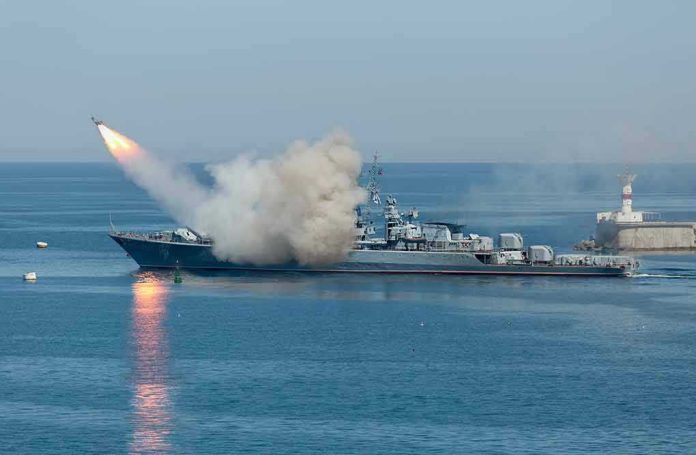
Iranian state media and officials denied United States assertions that Iranian boats were destroyed and claimed no commercial vessels had crossed the Strait of Hormuz recently, positioning Tehran’s actions as defensive against foreign navies [1]. United States Central Command and allied reporting countered that two United States Navy destroyers transited the strait after navigating an Iranian barrage, indicating allied forces maintained passage under threat [1]. United States accounts said Iranian strikes failed to disable American ships, directly contradicting Tehran’s claims of successful hits [4][8].
Ali Nikzad, deputy speaker of Iran’s parliament, stated Iran would not step back from the strait and that conditions would not return to a pre-war state, signaling a hard line on sovereignty and future maritime controls [1][2]. Iranian messaging also asserted that the United States favors military pressure over diplomacy, casting recent deployments as coercive rather than protective [1]. These positions parallel past Iranian attempts to shape maritime behavior, including talk of new regulatory mechanisms tied to the Revolutionary Guard, though corroborating documentation remains limited in public sources [2].
United States and Allied Framing of Defensive Operations
United States officials framed recent actions as lawful defense of an international waterway, with reports describing destroyers that fought off coordinated threats and continued their mission [4][8]. News coverage citing defense officials emphasized that attempts to control the strait violate international norms, a stance often linked to transit passage rights under global maritime law frameworks [4][9][11]. While the focus rests on United States briefings, fewer on-record statements from British or French authorities directly address specific maneuvers attributed to their ships, leaving some gaps in allied detail [1][2][4].
Incident reporting pointed to risk for commercial traffic. A cargo ship was attacked by small craft near the strait, with the crew reported safe, underscoring hazards to non-military vessels amid the standoff [2]. The International Crisis Group has tracked prior flashpoints where mirrored claims and denials escalated tensions, a pattern repeating now as each side disputes who initiated force and whether navigation rights were impeded [9]. This ambiguity reinforces anxiety among shippers and insurers, who must price voyages amid shifting military postures and contested narratives [2][9][14].
Economic Stakes and Legal Friction in a Narrow Chokepoint
The Strait of Hormuz carries a large share of the world’s seaborne energy, so disruptions quickly feed into costs across supply chains, from fuel to food. Recent reporting cited declines in traffic and vessels reversing course, reflecting market caution as near-miss incidents accumulate [14]. United States and European consumers, already stressed by inflation cycles and energy volatility, risk higher prices if insurers widen war-risk zones or reroute cargoes. Those pressures compound public frustration that geopolitical gambits hit household budgets first [14].
“Only stupid countries don’t shoot back when you’re shot at”
Marco Rubio, US Secretary of State, defends the US retaliation following an attack on a Navy ship, saying Iran started the confrontation and the response was warranted pic.twitter.com/CK0hAVqJKE
— TRT World (@trtworld) May 8, 2026
Legal clashes intensify uncertainty. Western officials point to navigation rights that permit continuous and expeditious transit, while Iranian officials suggest conditions or controls rooted in sovereignty and sanctions disputes [6][9][11]. Without transparent evidence—such as authenticated radar tracks, damage assessments, and independent imagery—claims about who fired first or who crossed which boundary remain contested [1][2][4][8]. That vacuum invites spin from all sides, widening the trust gap for citizens who suspect elite decision-makers obscure facts while the public shoulders the risk.
Sources:
[1] 2 U.S. Navy destroyers transit Strait of Hormuz after dodging Iranian …
[2] Cargo ship attacked near Strait of Hormuz with all crew reported safe
[4] Tensions persist in Strait of Hormuz amid US-Iran standoff – YouTube
[6] The Crisis Of American Sea Power In The Strait Of Hormuz
[8] U.S. destroyers in Strait of Hormuz fight off Iranian attacks – YouTube
[9] Strait of Hormuz | International Crisis Group
[11] The Strait of Hormuz: A U.S.-Iran Maritime Flash Point
[14] Strait of Hormuz Traffic Down As U.S. Blockade Appears to Deter …