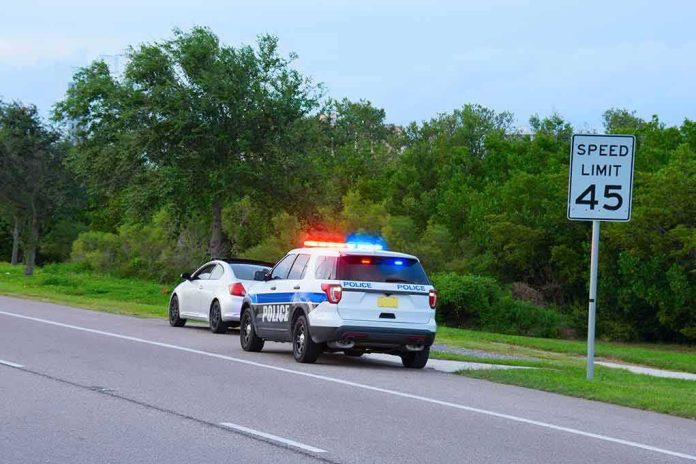
A tiny Alabama town turned routine traffic enforcement into a cash machine—and now a federal lawsuit is forcing a public reckoning over how easily government power can be weaponized against everyday drivers.
Story Snapshot
- Brookside, Alabama submitted a proposed $1.5 million class-action settlement for alleged “policing-for-profit” tactics used from 2018 to 2022.
- Reports say fines, fees, and forfeitures jumped 640% as traffic stops and tows surged, especially along Interstate 22.
- The proposal directs $1 million to people whose vehicles were towed and $500,000 to those charged through Brookside’s municipal court.
- Settlement terms include long-running reforms designed to sever police activity from revenue incentives, including limits on I-22 patrols and restrictions on fine revenue.
How a Town of 1,200 Became a Highway Revenue Collector
Brookside is a small town, but it sits near Interstate 22—an enforcement opportunity that allegedly became a business model. From March 2018 through August 2022, the town’s policing strategy shifted toward heavy traffic stops, aggressive ticketing, and frequent vehicle tows. According to reporting on the case, the town also imposed a $175 retrieval fee on towed vehicles, creating a direct, repeatable revenue stream from motorists passing through.
Three years after it made national news for running an outrageous speed trap, the tiny town of Brookside, Alabama has agreed to pay $1.5 million to settle a lawsuit over it. https://t.co/euIk86UeFL
— reason (@reason) February 11, 2026
Financial results in the public record and media coverage were stark. By 2022, Brookside’s revenue from fines, fees, and forfeitures was reported to have risen 640%. The allegations in the lawsuit argue that money flowed back into the policing apparatus itself, including purchases that critics said were meant to intimidate rather than protect. The controversy ultimately drew statewide attention, fueled public distrust, and set the stage for litigation centered on constitutional limits and basic due process.
The Lawsuit and the Proposed $1.5 Million Payout
The Institute for Justice, a public-interest law firm, filed the federal class action in 2022 on behalf of affected motorists, alongside co-counsel Dawson Law LLC. The settlement proposal—submitted for court approval in early February 2026—would allocate $1.5 million in compensation. Coverage of the agreement says $1 million is earmarked for people whose vehicles were towed, while $500,000 is designated for those who paid charges through Brookside’s municipal court.
The case matters because it highlights a failure point conservatives have warned about for years: when government can fund itself by squeezing citizens, it will. Even without debating every stop or citation, the incentive structure is the red flag. Systems that depend on fines and fees can pressure officials to treat ordinary Americans as revenue sources first and citizens second. That tension lands squarely on constitutional concerns raised in the reporting, including due process and Fourth Amendment protections.
What the Reform Package Would Change—If the Court Approves It
The proposed settlement is not just about checks; it is also designed to prevent a rerun. Reporting on the agreement describes a long-term framework restricting Brookside’s ability to rely on law-enforcement revenue. The structure spans 30 years, starting with a period where the town would be barred from taking any revenue from fines and fees, followed by capped percentages in later phases. The proposal also includes a permanent repeal of the $175 towing retrieval fee.
One of the most notable provisions would limit Brookside’s ability to patrol Interstate 22 for a decade, except for emergencies. That matters because the highway was central to the alleged volume strategy: a small town leveraging a major traffic artery to generate outsized enforcement activity. The agreement also describes transparency measures, including requirements tied to public budgeting and recorded meetings, reflecting how mistrust grows when government operates behind closed doors.
Where the Case Stands Now—and Why It’s a Broader Warning
As of February 2026, the settlement is still pending preliminary approval in U.S. District Court for the Northern District of Alabama. If the judge signs off, class members would have the option to file claims for compensation or opt out. Several key uncertainties remain based on the available reporting, including how many people ultimately qualify and how quickly payouts would be processed. Those details typically emerge during the claims administration phase.
For conservatives, the larger lesson is not partisan—it is structural. When local governments treat enforcement as a funding mechanism, the citizen-government relationship flips: rights become negotiable, and compliance becomes pay-to-play. The Brookside settlement proposal suggests courts can still function as a backstop against that kind of overreach, but it also shows the damage that can occur before anyone steps in. Reform that removes the profit motive is the only durable fix.
Sources:
Brookside accepts settlement, including $1.5 million compensation proposal
Brookside agrees to $1.5 million class action settlement over alleged policing-for-profit