
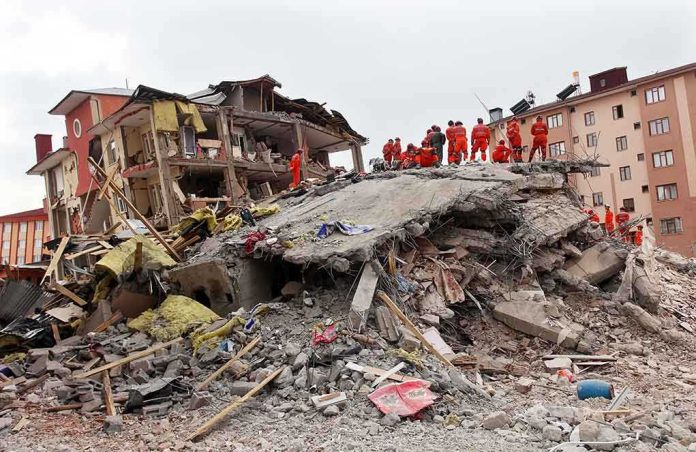
The most sobering detail from Kyiv this week is not the size of Russia’s missile barrage, but the fact that an entire slice of a modern apartment block simply ceased to exist between one breath and the next.
Story Snapshot
- Russia unleashed one of its largest combined missile and drone attacks of the war, with Kyiv as the main target [1].
- A section of a nine-story residential building collapsed, killing and injuring civilians, including children [1][2].
- Ukraine accuses Russia of deliberate terror against civilians; Russia, in turn, pushes alternative narratives about what hit the building [1].
- The strike exposes a deeper struggle over truth, law, and what “legitimate target” means in a modern urban war [1].
When “Military Targeting” Looks Like A Family Kitchen
Emergency crews in Kyiv described a scene that did not resemble a battlefield but a vertical graveyard: an entire chunk of a new residential block sheared away, rooms open to the night, children’s beds hanging over a pile of concrete and glass [1]. Residents had gone to sleep under what they were told was a “ceasefire atmosphere” and woke up to alarms, fire, and missing neighbors [3]. Rescue teams pulled survivors from the rubble while counting bodies, a process that stretched long into the next day [2].
Ukrainian officials say this building was not near an active military installation, ammunition depot, or command node [1]. The known casualty list reads like any American suburb: office workers, pensioners, a 12-year-old girl, parents who never made it to the shelter on time [1][2]. The Russian side has not produced credible evidence of a military target in the structure. That matters, because under the laws of war, “we were hitting infrastructure somewhere in the city” is not a legal defense for leveling people’s homes .
The Barrage Pattern And What It Tells Us
Ukraine’s air force and local authorities describe the assault as one of the war’s largest: a combined wave of drones and missiles hitting Kyiv and multiple other cities over a single night and into the following day [1][3]. Reports mention dozens of missiles and hundreds of drones launched in coordinated fashion, aimed at critical energy systems, command centers, and—repeatedly—densely populated urban districts [1][3]. Air defenses intercepted many of the incoming weapons, but even a small percentage getting through proved enough to demolish entire buildings [3].
The strike on the apartment block fits a wider pattern documented since Russia began systematically targeting Ukraine’s power grid and urban infrastructure in 2022: broad salvos that mix genuinely military targets with high-risk strikes near civilian neighborhoods . From a hard-nosed, conservative perspective, the moral and legal test is simple: did the attacker take feasible precautions to avoid civilian harm and choose targets with a clear, concrete military advantage? When entire residential complexes collapse without evidence of legitimate military use, that standard looks badly abused [1].
The Blame Game: Missiles, “Accidents,” And Manufactured Doubt
Once bodies appear in the rubble, the second battle begins: the struggle over who is responsible. Russian state outlets and aligned commentators have a track record of claiming that destroyed Ukrainian apartment blocks were actually hit by stray Ukrainian air defense missiles, not Russian weapons . After a previous strike on Kyiv’s Solomianskyi district, Russian narratives pushed exactly that line, only to run into forensic analysis and debris identification that pointed back at Russian systems .
Ukrainian rescuers, for an entire day, have been pulling the bodies of civilians from a Kyiv apartment building, killed by Russia in the largest missile strike since 2022
The confirmed death toll has reached 8, and at least 20 people remain missing beneath the rubble
📷 DSNS pic.twitter.com/VqFchgDMDF— Euromaidan Press (@EuromaidanPress) May 14, 2026
The same rhetorical pattern is emerging again. Yet open-source visuals and eyewitness testimony from this latest attack describe a familiar sequence: sirens, incoming drones and missiles, explosions across the city, and then a direct hit, followed by structural collapse of the residential building [1][2]. Even if a defending missile contributed to the final damage, common sense says the country firing the original barrage into a city of millions created the lethal situation. You do not get to break into the house, start shooting, and then claim innocence because someone’s defensive shot ricocheted.
What “Escalation” Really Means For The Rest Of Us
European and North American leaders now openly describe Russia’s approach as one of deliberate escalation rather than any good-faith move toward negotiation . The logic is brutal but clear: punish Ukraine’s cities until either the population breaks or Western support falters. Large-scale attacks that flatten apartment blocks send a message not just to Kyiv, but to every capital weighing how many missiles and air defense systems to ship east [1][3]. Moscow is betting that images of ruin will eventually make Western voters tired.
For Americans who care about sovereignty, borders, and a rules-based order that keeps great powers from casually erasing smaller neighbors, this apartment block is more than another faraway tragedy. It is a test case. If a state can repeatedly smash civilian high-rises while hiding behind vague talk of “infrastructure” and never face real consequences, the precedent does not stay in Eastern Europe. It travels—to the Baltic states, to the Pacific, to every place where a stronger neighbor eyes a weaker one and wonders what it can get away with .
Why This One Building Matters So Much
One collapsed structure in Kyiv will not decide the war, but it distills the stakes: who defines reality, whose lives count, and whether the line between soldier and child still means anything once the shooting starts. Ukrainian rescuers pulling bodies from the wreckage do not have the luxury of debating “legitimate targets.” They see only apartments turned into open graves [1][2]. The rest of us, watching from a safe distance, still have a choice about what we call it—and what we are willing to tolerate.
Sources:
[1] Web – Russia destroyed a section of a 9-story Kyiv apartment block …
[2] Web – Apartment Block Collapses In Kyiv During Massive Russian Attack
[3] Web – Russian drone attack hits Kyiv apartment block during ceasefire