
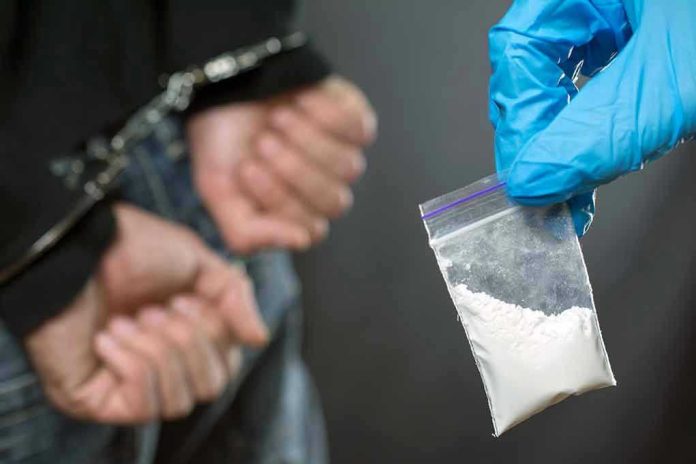
A powerful new street sedative is turning Philadelphia’s already-devastated drug scene into a full-blown “withdrawal crisis” that exposes years of failed left-wing drug and border policies.
Story Highlights
- A veterinary sedative called medetomidine has rapidly contaminated Philadelphia’s fentanyl supply and is driving a new, severe withdrawal crisis.
- Doctors report 165 hospitalizations in just four months with life-threatening withdrawal that standard protocols cannot control.
- Medetomidine now appears in the vast majority of tested fentanyl samples and in a significant share of fatal overdoses.
- Philadelphia’s ordeal shows how a wide-open border, lax enforcement, and “harm reduction first” ideology have failed families and communities.
Medetomidine: The New Threat in an Already Broken Drug Landscape
Philadelphia, already ground zero for fentanyl and xylazine, is now battling a new chemical menace: medetomidine, a powerful veterinary sedative never approved for human use. Within months, toxicology labs found it had replaced xylazine as the dominant adulterant in the city’s illicit fentanyl supply, showing up in roughly 87 percent of street samples by early 2025. Doctors now describe a distinct “medetomidine withdrawal syndrome,” with severe surges in blood pressure, racing heart rates, and uncontrolled agitation.
Clinicians across three major Philadelphia health systems documented 165 hospitalizations between September 2024 and January 2025 in which fentanyl withdrawal was complicated by suspected medetomidine withdrawal, often requiring intensive care. Many patients arrived in extreme distress, and standard opioid or xylazine withdrawal regimens simply did not work. Instead, hospitals turned to continuous infusions of dexmedetomidine, a related sedative typically used in tightly controlled ICU settings, consuming scarce beds and staff time.
Evidence of a Fast-Mutating, Poorly Controlled Drug Supply
In just a few years, Philadelphia’s street supply has lurched from heroin to fentanyl, then to “tranq dope” cut with xylazine, and now to fentanyl heavily laced with medetomidine. By late 2024, xylazine detection in samples had plunged while medetomidine became the most common contaminant. Preliminary city data show medetomidine in about 15 percent of all fatal overdoses from May 2024 to May 2025, even as emergency room visits for withdrawal complaints nearly tripled, from around 800 to nearly 2,400 in a single year.
Unlike classic opioid overdoses, medetomidine-related cases often do not respond to naloxone, leaving first responders guessing as patients slip into unconsciousness with dangerously slow heart rates. When the drug finally clears, the withdrawal slams patients with severe hypertension, tremors, and agitation that can spiral into life-threatening autonomic instability. This pattern reinforces what many conservatives have warned for years: an unregulated, ever-shifting black market will always stay ahead of bureaucratic public-health responses, especially when border control and tough enforcement take a back seat to slogans.
Kensington’s Open-Air Crisis and the Cost to Families and Communities
The epicenter of this new wave is Kensington, the infamous open-air drug scene that has become a national symbol of urban decay and policy failure. For years, residents have watched encampments expand, public drug use become normalized, and violent trafficking flourish while city leaders doubled down on “harm reduction,” supervised use, and treatment over arrest. By 2025, nearly half of Philadelphians report knowing someone with opioid use disorder, and about one in three know someone who has died from an overdose, a staggering toll on families.
Polls now show strong majorities favor expanding treatment and services, but that sentiment exists alongside deep frustration with deteriorating quality of life, especially in the River Wards that include Kensington. Parents navigate sidewalks littered with needles and human waste, small businesses board up storefronts, and law-abiding residents feel abandoned. For conservative readers, this is the predictable outcome when progressive leaders treat enforcement as a last resort and refuse to confront the criminal networks driving these drug innovations.
Public Health Scrambles While Systems Struggle to Keep Up
To their credit, some clinicians and public-health officials in Philadelphia moved faster on medetomidine than they did on fentanyl or xylazine. Drawing on those earlier failures, the Philadelphia Department of Public Health worked with hospital teams and the CDC to issue clinical guidance in June 2025, barely nine months after the crisis surfaced. The guidance outlines how to recognize the new withdrawal syndrome and when to escalate to dexmedetomidine infusions and ICU-level monitoring, giving frontline doctors at least a basic playbook.
Even so, hospitals remain under intense strain. Medetomidine clears quickly from the body and lacks its own billing code, making it tough to track cases or plan resources. Intensive-care beds are consumed by withdrawal that older protocols cannot handle, and drug-checking systems struggle to keep up with constant changes in street chemistry. This is precisely where a national strategy that combines tough border security, aggressive targeting of traffickers, and serious treatment funding could support local systems instead of forcing them to improvise under pressure.
For conservatives, the medetomidine story is not just about another drug; it is about a political class that tolerated open-air markets, soft-on-crime prosecutors, and porous borders until neighborhoods collapsed. Trump’s renewed focus on closing the border, designating major cartels as terrorist organizations, and enforcing the law sends a different message: communities, not cartels, come first. Philadelphia’s ordeal should be a warning and a call to back policies that defend families, restore order, and finally put Americans’ health and safety ahead of ideology.
Sources:
A new, potent street drug is causing severe withdrawal, and doctors are scrambling to treat it
DEA Operation Engage: Philadelphia
Philadelphians’ perspectives on the opioid crisis are shifting
New plan for opioid crisis in Philadelphia’s Kensington section offers treatment instead of jail
Compassionate connections are key to xylazine-related care