
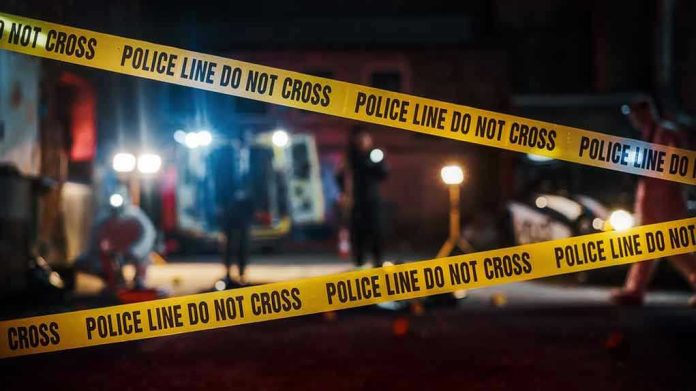
A California son’s brutal knife attack that left his stepmother dead and his father gravely wounded is forcing hard questions about mental illness, crime, and whether California’s justice system is really protecting families.
Story Snapshot
- A 34-year-old California man stabbed his stepmother to death and seriously injured his father after a domestic argument in rural Shandon.
- Security video shows him chasing his stepmother outside the home and stabbing her at least seven times as she screamed for help.
- The father described his son’s eyes as “completely black, no whites,” underscoring a terrifying mental break.
- The attacker, long flagged with mental-health issues, was once ruled incompetent but ultimately sentenced to 30 years to life.
Deadly Family Attack in Small-Town California
On a July evening in 2023, in the quiet rural community of Shandon, California, 34-year-old Justin Tray Buchanan turned a family argument into a deadly knife rampage inside his parents’ home. According to investigators and court records, Justin armed himself with a knife during the dispute and attacked his stepmother, Kelly Jean Buchanan, and his father, William Louis Buchanan, inflicting multiple wounds. William suffered serious injuries and survived, but Kelly did not, leaving a shattered family and a shaken small town behind.
Security footage later reviewed in court showed the horror spilling outside the house, where Kelly tried desperately to escape. Video captured Justin chasing her around the home, tackling her in the yard, and stabbing her at least seven times while she screamed for help. A neighbor, Sergio Rangel, heard the cries and ran toward danger, physically confronting Justin. Rangel was assaulted with the knife but escaped serious injury, likely preventing even more bloodshed on that brutal night.
‘No Whites in His Eyes’ and the Mental-Health Question
About a year after the attack, at a preliminary hearing, William Buchanan tried to describe what he had seen in his own son’s face as the violence exploded. He testified that Justin’s eyes went “completely black, no whites in his eyes,” language that reporters compared to someone being possessed. Prosecutors and family members alike pointed to Justin’s long-running mental-health struggles, and at one point he was ruled incompetent to stand trial, sending him into the familiar limbo between treatment and accountability.
The case hits a nerve for many conservatives who have watched blue-state leaders underfund real mental-health treatment while fixating on social-engineering agendas. Families are left to navigate serious psychiatric problems with limited support, and when things go horribly wrong, they are told to trust the same bureaucracies that failed them. This tragedy shows what happens when mental illness, family tension, and a justice system slow to act collide, leaving innocent people—often women—utterly exposed in their own homes.
Justice System Response and a 30-to-Life Sentence
Once Justin was finally found competent, prosecutors in San Luis Obispo County pushed the case forward through the standard California criminal process: preliminary hearing, plea negotiations, and sentencing. He ultimately pleaded guilty to murdering Kelly, attempting to murder his father, and assault with a deadly weapon for the knife attack on neighbor Rangel. A county judge imposed a sentence of 30 years to life in state prison, reflecting California’s penalties for murder with additional violent enhancements tied to the surviving victims.
At sentencing, Justin apologized and asked his family for forgiveness, reportedly telling the court that he had “turned into a monster” that night. The judge picked up on that phrase, urging him to use his years behind bars to address his mental-health issues. San Luis Obispo County District Attorney Dan Dow called the killing a tragedy of family violence and emphasized that the stiff sentence was meant to send a strong message: in his county, those who brutalize their own families will face the harshest punishment the law allows, not a slap on the wrist or a quiet plea-down.
Victims, Community, and Broader Cultural Concerns
For Kelly’s loved ones, no sentence can restore what was stolen. Her mother, Nancy Duckworth, delivered an emotional statement describing a permanent wound, saying that nothing will ever feel “good or fine again.” William must live with serious physical injuries along with the emotional burden of knowing his son nearly killed him and did kill the woman he loved. Neighbor Sergio Rangel, praised as a courageous bystander, will carry memories of the screams and the struggle every time he walks past that yard.
Stories like this also resonate in today’s political climate, where many readers are exhausted by years of soft-on-crime rhetoric and excuses for violent offenders. While this particular case ended with a substantial prison term, it unfolded in a state known for revolving-door justice and leniency backed by activist prosecutors. For law-and-order conservatives, the lesson is clear: families deserve a system that prioritizes their safety, confronts dangerous behavior early, and treats mental illness seriously without using it as a shield against responsibility.
Sources:
‘No Whites in His Eyes’: California Man Stabs Stepmom to Death, Seriously Injures Dad
California Stepmom and Father Accused of Torturing Children in Abuse Case