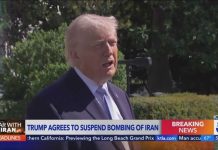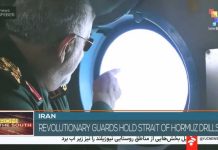
With gas prices and energy security on the line, President Trump’s new 48-hour ultimatum to Tehran is forcing MAGA voters to ask the question they hoped they’d never face again: are we drifting into another Middle East war?
Quick Take
- President Trump issued a renewed 48-hour warning to Iran to reopen the Strait of Hormuz or face major U.S. military retaliation.
- Iran’s blockade has triggered a worldwide energy crisis, since roughly 20% of global oil and natural gas moves through the strait.
- A U.S. F-15E was shot down over Iran as the crisis escalated, and U.S. forces are reportedly searching for a missing crew member.
- Pakistan has served as a mediator for a U.S. plan that Iran rejected, though Tehran signaled talks may still be possible.
Trump’s 48-hour ultimatum raises the stakes overnight
President Donald Trump renewed a hard deadline on April 4, 2026, warning Iran that “Time is running out – 48 hours before all Hell will reign down on them” unless Tehran makes a deal or reopens the Strait of Hormuz. Trump’s message referenced an earlier window he said he had already granted. The warning arrives as the strait remains effectively blocked, with global energy markets reacting to a supply choke point few Americans can ignore.
Trump’s earlier language set the tone for what “or else” could mean. On March 30, he publicly threatened strikes intended to “blow up and completely obliterate” Iranian electric generating plants, oil wells, and Kharg Island—plus even the possibility of hitting desalination plants. Those targets would represent a sharp escalation from economic pressure to direct infrastructure warfare. The administration’s posture is now central to whether the crisis ends at the negotiating table or expands into open conflict.
Why the Strait of Hormuz matters to American families
The Strait of Hormuz is a narrow chokepoint between Iran and Oman—about 21 miles wide at its narrowest—through which roughly 20% of global oil and natural gas shipments pass. When that artery is constricted, the effects hit Americans fast through higher fuel prices, costlier shipping, and broader inflation pressure. For voters already worn down by years of elevated living costs, the Hormuz crisis turns foreign-policy theory into a kitchen-table problem.
Iran has threatened or disrupted traffic through Hormuz during past standoffs, and history shows how quickly accidents, miscalculations, or provocations can spiral. The current blockade has already been described as contributing to a worldwide energy crisis. The practical question for U.S. policymakers is not just how to restore shipping, but how to do it without stumbling into a prolonged conflict that drains U.S. readiness, spending, and national focus—exactly what many conservative voters rejected.
The military picture darkens after a U.S. jet is downed
The crisis intensified on April 3, when an American F-15E jet fighter was shot down over Iran, according to the available reporting, and U.S. forces began searching for a missing crew member. That single event changes the atmosphere: deadlines and social-media warnings turn into operational realities when U.S. service members are at risk. Any recovery effort under hostile conditions also raises the chance of additional clashes, misidentification, and rapid escalation.
Key details remain limited in the current public record, including the full circumstances of the shootdown and what channels are being used to manage deconfliction. With only one detailed report available, there is an information gap conservatives should recognize before drawing sweeping conclusions about the incident itself. Still, the strategic reality stands: once U.S. aircraft are being lost and crews are missing, political pressure for retaliation rises, and diplomatic off-ramps narrow.
Diplomacy through Pakistan continues, but the window is closing
Pakistan has served as a mediation channel, carrying what was described as a 15-point U.S. plan. Iran rejected that plan, while leaving open the possibility of further negotiations. That mixed response matters because it signals the crisis is not purely military; it is also a high-stakes bargaining contest over leverage, credibility, and what each side believes it can force the other to accept. Trump’s deadline strategy appears aimed at compressing time and raising costs for delay.
For the Trump coalition, the political tension is obvious: many voters support strong deterrence and protecting U.S. interests, but they are also deeply skeptical of “forever wars” and open-ended commitments that enrich bureaucracy while burying American priorities at home. With energy prices already sensitive, Washington’s challenge is to restore maritime security without sliding into a regime-change mindset or an undefined campaign that could outlast any news cycle—and outlast public patience.
Sources:
Trump Gives Tehran 48 Hours To Make Deal, Open Strait Or Face ‘Hell’